Lower Body Plan: Beginner Build-Up

He follows your setup: two leg days a week, single-leg one week, both legs the next. Each exercise starts as a machine or supported version and climbs a 4-phase ladder. By Phase 4 (about week 19) he is doing your template as written, with barbell squats added.

Rep range and sets to failure

Working sets run 5 to 10 reps, down from 12 to 15 in the first version of this plan, and the weight goes up to match. Muscle and strength adaptations happen across a wide range of weights, and heavier weight favors strength (Schoenfeld 2021). Small machine exercises (hip adductor, hip abductor, calf raise) run 8 to 12.

Failure is the point where he cannot finish another rep with clean form. Muscle growth improves as sets end closer to failure, and strength gains are similar however close a set ends (Robinson 2024). There is no evidence that going all the way to failure grows more muscle than stopping short (Refalo 2023).

On machines a missed rep costs nothing, so those sets go to failure. Free-weight lifts, single-leg ones included, stop 1 to 2 reps short (1 in Phase 4), because a missed rep there means a fall or a rounded back.

Phases

PhaseWeeksFocusSets x repsEffort
1 Foundation1–6Machines, two-leg versions, mobility, balance practice2 x 8–10Stop 2 reps short of failure. From week 3, the last set on each machine goes to failure
2 Build7–12Single-leg machines, supported free-weight versions2–3 x 6–10Machines: last set to failure. Free weights: stop 1–2 reps short
3 Load13–18Goal patterns with light dumbbells3 x 6–8Machines: every set to failure. Free weights: stop 1–2 reps short
4 Goal lifts19+Barbell squat, barbell RDL, weighted lunges, BSS3 x 5–8Machines: every set to failure. Free weights: stop 1 rep short

Weekly schedule

WeekLeg day 1Leg day 2
Odd weeks (1, 3, 5…)Day C: Quads & Glutes (both legs)Day D: Hamstrings & Glutes (both legs)
Even weeks (2, 4, 6…)Day A: Glutes & Quads (single)Day B: Glutes & Hamstrings (single)
  • Start with a both-legs week. Those days are mostly machines, where he is already confident.
  • In weeks 1–2 no set goes to failure, to keep soreness manageable.
  • Put 2–3 days between the two leg days, e.g. Mon and Thu.
  • Each day comes up only every other week, so phases run 6 weeks (3 rounds of each day). The squat and balance practice is in the warm-up so he gets it every leg day.

Training rules

  • If form breaks (heels lift, back rounds, knee caves in), the set is over, even with reps left.
  • Only machines go to failure. Before a failure set on the hack squat or leg press, set the safety stops.
  • Before the first exercise's working sets, do one lighter set: about half the working weight for 8 easy reps.
  • Rest 2–3 minutes between hard sets. In trained men, 3-minute rests built more strength and thigh muscle thickness than 1-minute rests (Schoenfeld 2016).
  • Lower every rep for a slow 3 count in Phases 1–2. That builds control while the weights are new.
  • Add weight with double progression: when every set hits the top of the rep range with clean form, add the smallest step (5–10 lb on two-leg machines, 5 lb on single-leg machines or each dumbbell). Then start again at the bottom of the range.
  • Move to the next phase by the checkpoints in the road map below, not the calendar. Staying in a phase longer is fine.
  • Starting weights below are guesses for a 260 lb beginner, raised about 10 lb from the 12–15 rep version of this plan, and machines vary. In the first session, pick a weight that lets him finish the full reps and stop 2 short of failure, and write it down.

Warm-up and practice

Every leg day, 10–12 minutes

This block fixes what blocks his lunges and squats: stiff ankles, tight hips and balance. Do it before every leg day. The ankle rocks and hip stretch also work on rest days. Nothing here goes to failure.

Incline walk or bike

5 min, easy pace.
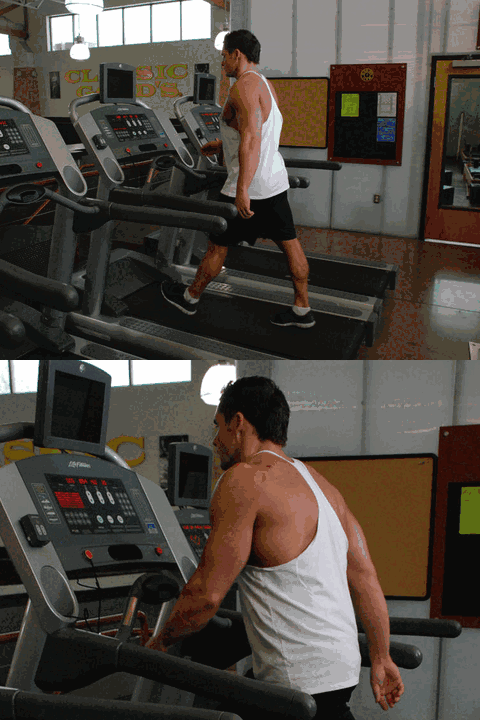
Incline walk: start and finish positions, looping
Incline walk

Knee-to-wall ankle rocks

2 x 10 per side. Foot a few inches from the wall, heel pinned down, drive the knee forward over the pinky toe until it touches. Move the foot back as it gets easier. Goal: about 4–5 inches from the wall with the heel down.

Knee-to-wall ankle rocks
Watch the video for knee-to-wall ankle rocks

Squat practice: heel-elevated box squat

2 x 8, bodyweight. Heels on 10 lb plates or a wedge, feet a bit wider than shoulders, toes out slightly. Sit back to a bench (about 18") with control, touch, stand up. Hold a light dumbbell at the chest if it helps him balance.
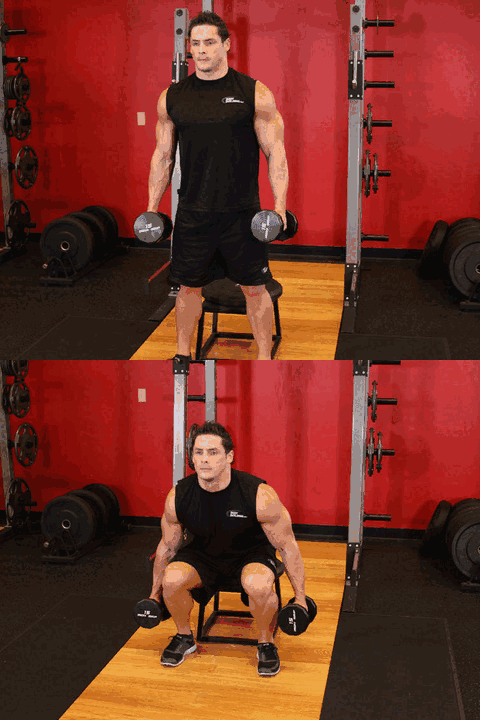
Squat to a bench: start and finish positions, looping
Squat to a bench. Shown with dumbbells and flat feet. He starts with bodyweight and raised heels.
Watch the video for squat to a bench

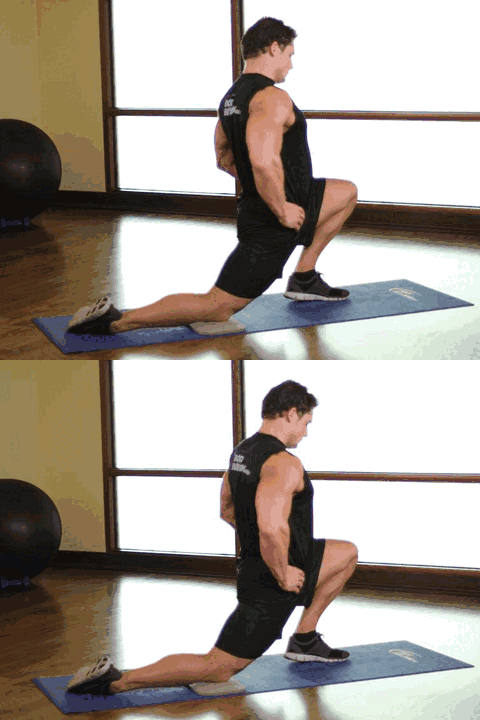
Balance practice: split-stance hold

2 x 20–30 sec per side. Long staggered stance, feet hip-width apart side to side, back knee bent a few inches. Progress from both hands on a rack, to fingertips, to no hands. The video holds deeper, with the knee just off the floor. He works toward that.

Split-stance hold
Watch the video for split-stance hold

As the checkpoints are met, swap in the harder versions: lower box, then no heel lift for the squat; a slow split squat for the hold.

Phase filter

Even weeks

Day A: Glutes & Quads (single)

Same four exercises as yours. The single-leg machines start as two-leg versions for Phase 1, and step-ups start low with a hand on the rack. Phase 4 is your template as written, at his weights.

Glutes, Quads Inner thigh

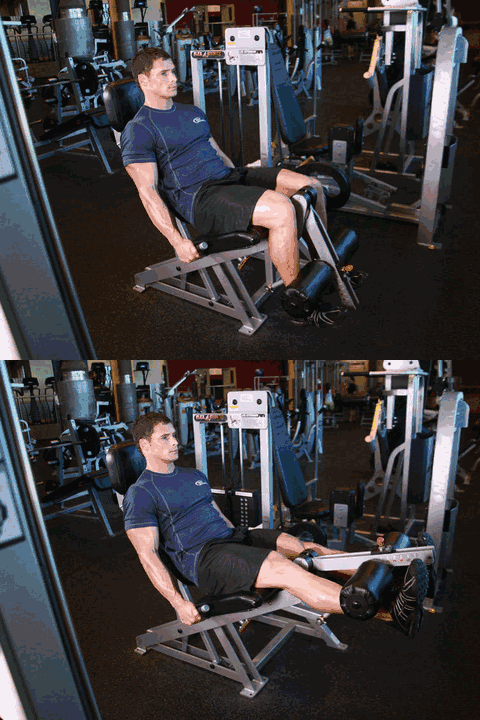
Leg extension

Quads

Leg extension: start and finish positions, looping
Leg extension
Single-leg leg extension: start and finish positions, looping
Single-leg leg extension
  1. Phase 1Both legs, 2 x 8–10, start ~60–80 lb
  2. Phase 2Single leg, 2–3 x 8–10, start ~30–40 lb
  3. Phase 3Single leg, 3 x 8–10, add 5 lb as earned
Leg extension machine
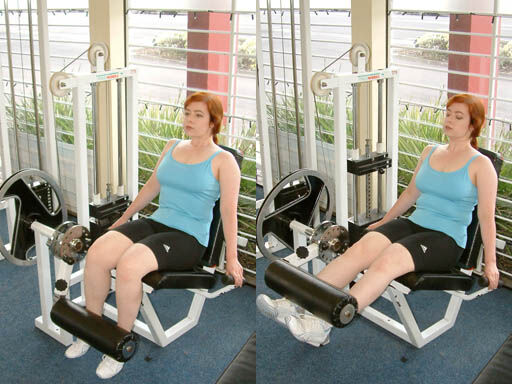
Leg extension machine. Photo: GeorgeStepanek, CC BY-SA 3.0

Step-ups

Quads, Glutes

Step-up: start and finish positions, looping
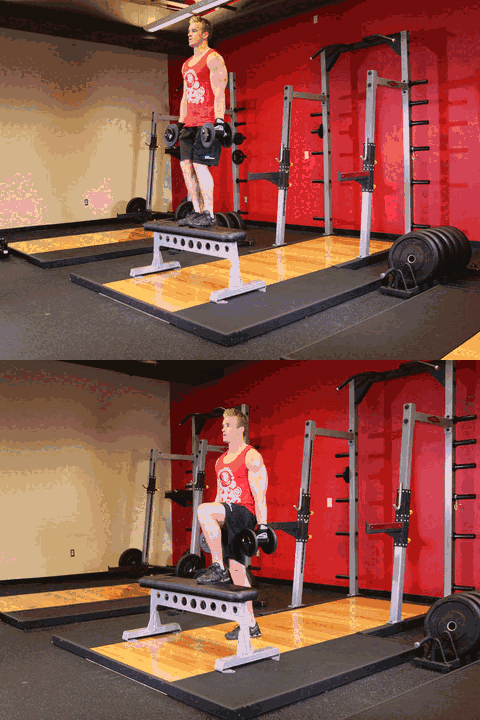
Step-up. Shown with dumbbells, which arrive in Phase 3.
  1. Phase 18–12" step, one hand on a rack, bodyweight, 2 x 6–8 per leg
  2. Phase 214–16" box, no hands, 3 x 6–8 per leg
  3. Phase 316–18" box, dumbbells 15–25 lb each, 3 x 6–8 per leg

Leg press

Quads, Glutes

Leg press: start and finish positions, looping
Leg press
  1. Phase 1Both legs, 2 x 8–10, start ~160–200 lb on the sled
  2. Phase 2Single leg, 2–3 x 6–10, start ~80–100 lb
  3. Phase 3Single leg, 3 x 6–8, build toward your 167 lb and past it
Leg press sled
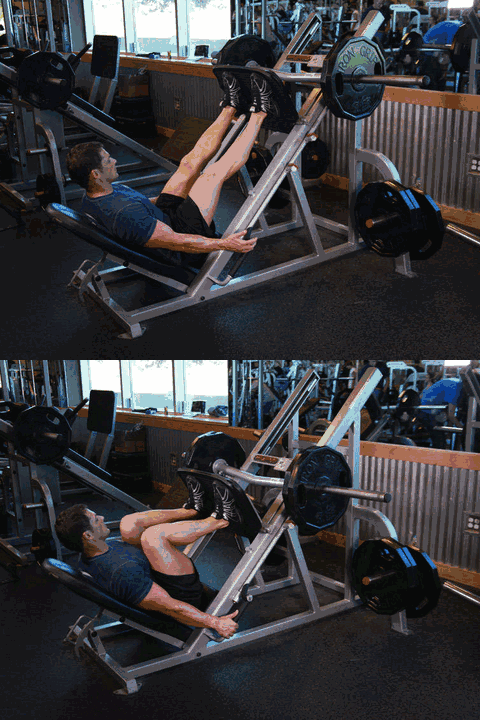
Leg press sled. Photo: Teemeah, CC BY-SA 4.0

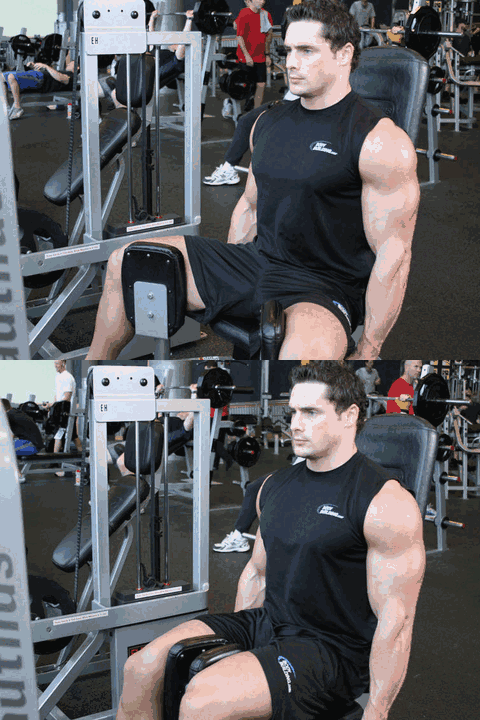
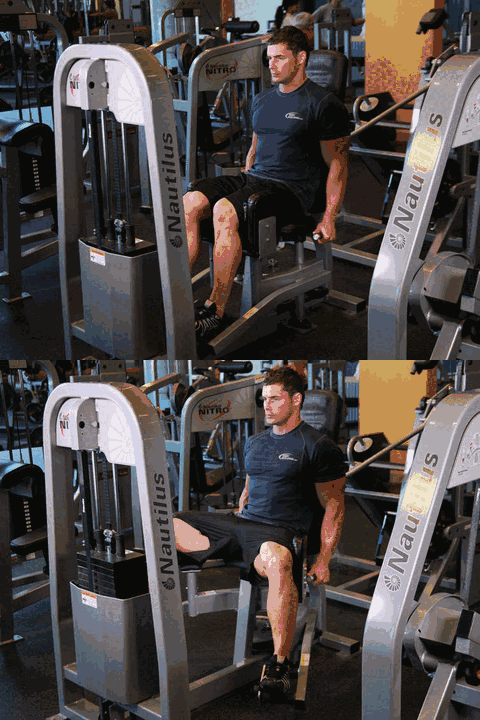
Hip adductor

Inner thigh

Hip adductor machine: start and finish positions, looping
Hip adductor machine
  1. Phase 12 x 10–12, start ~70–90 lb
  2. Phase 22–3 x 8–12
  3. Phase 33 x 8–12, add 5–10 lb as earned

Hip adductor machine. The animation above shows this machine.

Form notes

  • Step-ups: whole foot on the box. Drive through the heel of the top leg and don't push off the bottom toe. Step down slowly. At 260 lb, his bodyweight alone is a heavy load here.
  • Leg press: feet shoulder-width or a bit wider, mid-to-high on the platform. That gives his belly room and keeps the heels down. Lower until the knees are near 90°, and stop before the low back peels off the pad.
  • Leg extension: 1-sec squeeze at the top, slow lowering. If the knees ache, shorten the range at the bottom.

Even weeks

Day B: Glutes & Hamstrings (single)

This is the day his balance and flexibility limit most. The single-leg RDL and Bulgarian split squat start as supported versions and earn their way to the real thing.

Glutes, Hamstrings Quads, Outer hip, Low back

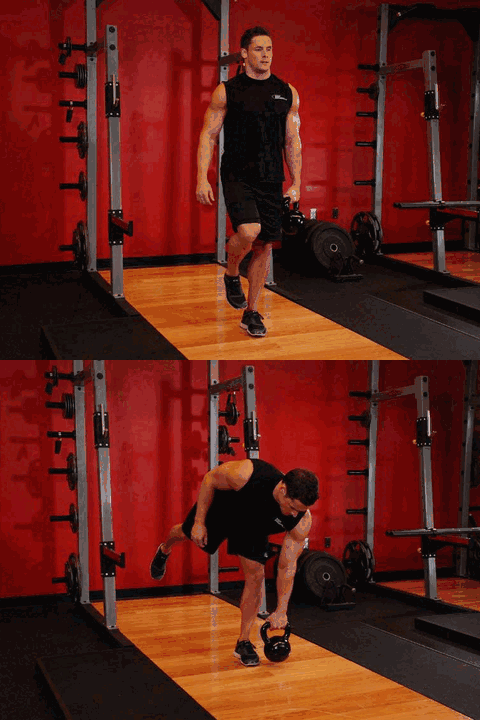
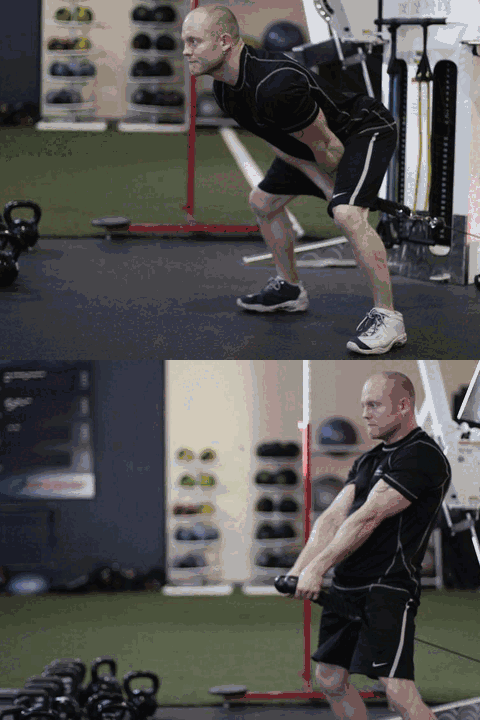
Single-leg RDL

Hamstrings, Glutes, Low back

Single-leg RDL: start and finish positions, looping
Single-leg RDL. Shown with a kettlebell. A dumbbell works the same way.
  1. Phase 1Skip for now. The EPIC Glute machine covers this slot while he learns the hinge on Day D
  2. Phase 2Kickstand RDL (back toe on the floor for balance), one 20–30 lb dumbbell, hand on a rack, 3 x 6–8 per side
  3. Phase 3Single-leg RDL, hand on a rack, 25–35 lb dumbbell, 3 x 6–8 per side

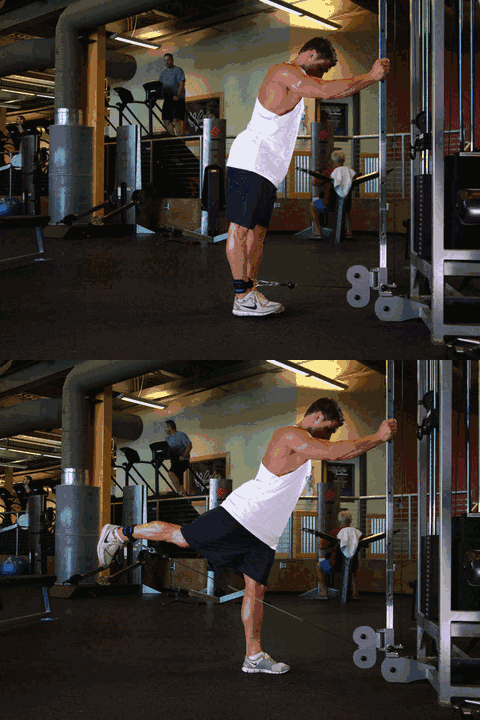
EPIC Glute machine added

Glutes, Hamstrings

Standing glute kickback: start and finish positions, looping
Standing glute kickback. Shown on a cable. The EPIC Glute machine uses the same hip drive and adds a chest pad and handles.
  1. Phase 12 x 8–10 per leg, start ~40–60 lb
  2. Phase 22–3 x 8–10 per leg
  3. Phase 33 x 6–10 per leg, add 5 lb as earned

EPIC Glute machine. The standing machine with a chest pad and two handles.

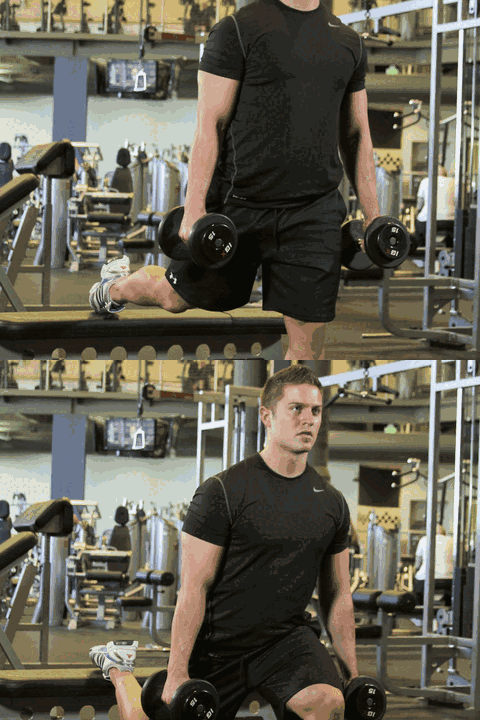
Bulgarian split squat

Quads, Glutes

Bulgarian split squat: start and finish positions, looping
Bulgarian split squat. The Phase 3 version. Phases 1 and 2 keep the back foot on the floor.
  1. Phase 1Supported split squat: back foot on the floor, both hands on a rack, partial depth, 2 x 6–8 per leg
  2. Phase 2Split squat, full depth (back knee to a pad), one hand then no hands, 3 x 6–8 per leg
  3. Phase 3Back foot on a 6–8" step, then a bench; bodyweight first, then dumbbells 10–20 lb, 3 x 6–8 per leg

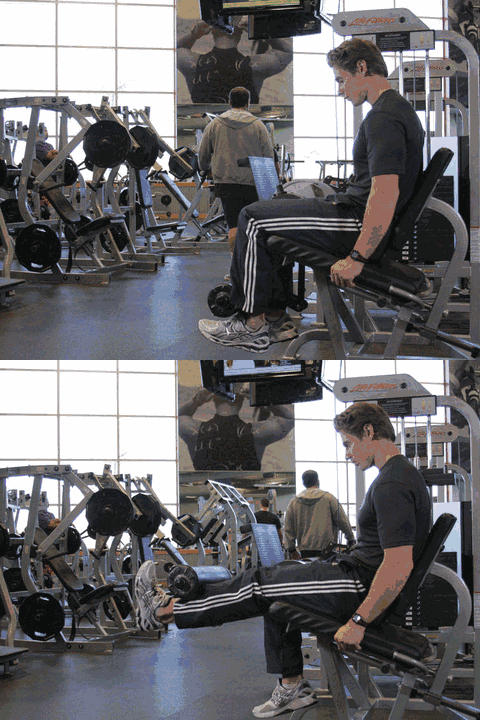
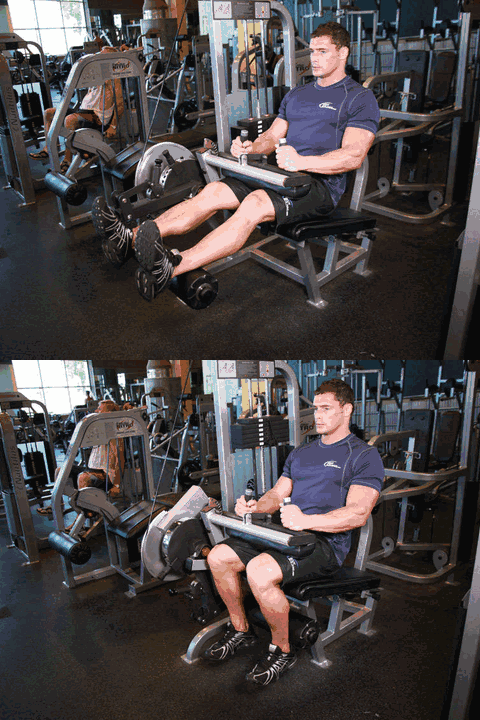
Seated leg curl

Hamstrings

Seated leg curl: start and finish positions, looping
Seated leg curl
  1. Phase 1Both legs, 2 x 8–10, start ~60–80 lb
  2. Phase 2Both legs, 2–3 x 6–10
  3. Phase 3Single leg, 3 x 6–10, start ~half the two-leg weight

Seated leg curl machine. The animation above shows this machine.

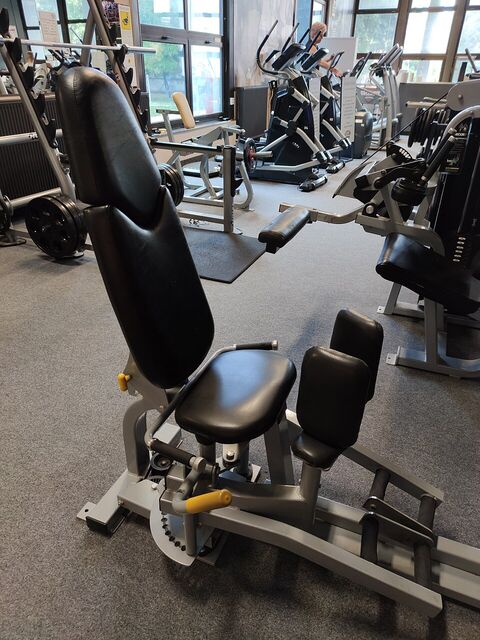
Hip abduction

Outer hip, Glutes

Hip abductor machine: start and finish positions, looping
Hip abductor machine
  1. Phase 1Seated machine, both legs, 2 x 10–12, start ~70–90 lb
  2. Phase 2Seated machine, 2–3 x 8–12
  3. Phase 3Single leg (cable or standing machine), 3 x 8–12 per side
Hip abductor machine
Hip abductor machine. Photo: Teemeah, CC BY-SA 4.0

Form notes

  • Split squat stance: feet hip-width apart side to side, like train tracks, not a tightrope. This alone fixes much of the wobble. At 6'4" he needs a long stride. Drop straight down rather than forward.
  • Kickstand and single-leg RDL: push the hips back toward the wall behind him, with a soft knee and a flat back. Stop when the hamstring stretches or the back starts to round. Early on that may be just below the knee.
  • Bulgarian split squat bench: he should be able to set the back foot without hopping. Start on a low step and only move to the bench once that feels steady.
  • EPIC Glute machine: set the chest pad so he stands tall with his hips square, hands on the handles. Drive the working leg straight back through the heel and squeeze the glute at the end. Stop before the low back arches, since the motion should come from the hip. A slight bend in the standing knee keeps that leg and his core working on balance.

Odd weeks

Day C: Quads & Glutes (both legs)

This is his strongest-confidence day: all machines, plus one added calf raise to help his ankles. The hack squat is his bridge to barbell squats, because the sled supports his back while he learns depth.

Quads, Glutes Inner thigh, Calves

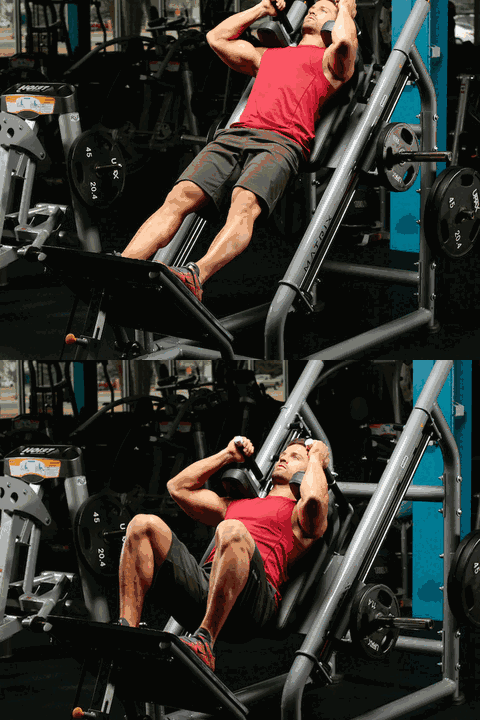
Hack squat

Quads, Glutes

Hack squat: start and finish positions, looping
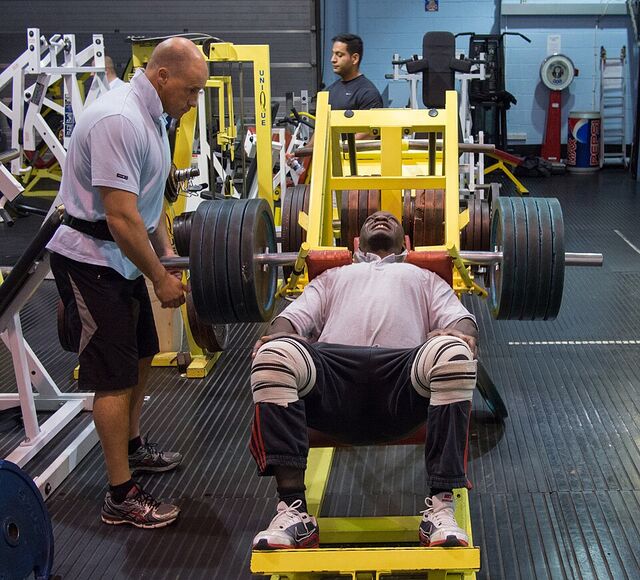
Hack squat
  1. Phase 1Empty sled or +25 lb, 2 x 8–10, only as deep as his heels stay down
  2. Phase 22–3 x 6–10, add 10 lb as earned, a little deeper each round
  3. Phase 33 x 6–8, thighs to parallel
Hack squat machine
Hack squat machine. Photo: brett jordan, CC BY 2.0

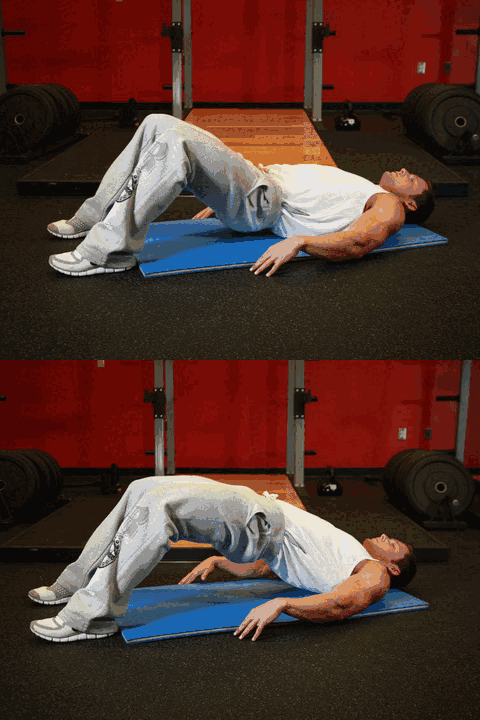
Hip thrust

Glutes, Hamstrings

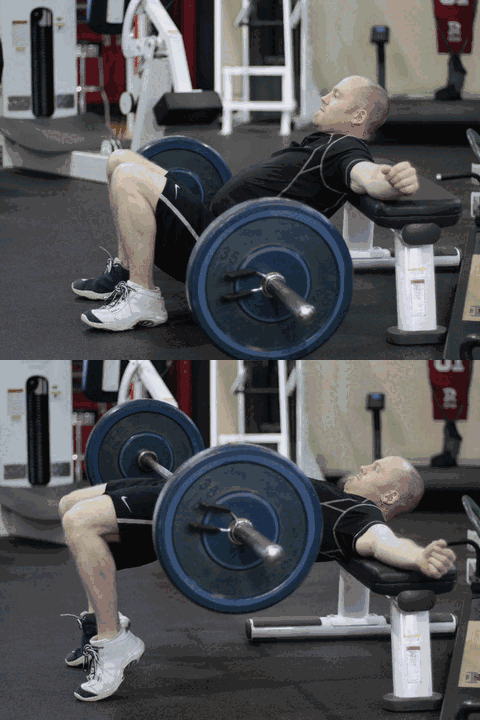
Hip thrust: start and finish positions, looping
Hip thrust. The barbell version from Phase 3. The machine follows the same path.
  1. Phase 1Hip thrust machine or floor glute bridge, 2 x 8–10
  2. Phase 2Machine or barbell with a thick pad, 2–3 x 6–10
  3. Phase 3Barbell, 3 x 6–8

Hip thrust machine. A padded bench with a belt or roller across the hips.

Leg extension

Quads

Leg extension: start and finish positions, looping
Leg extension
  1. Phase 1Both legs, 2 x 8–10, start ~60–80 lb
  2. Phase 22–3 x 8–10
  3. Phase 33 x 8–10
Leg extension machine
Leg extension machine. Photo: GeorgeStepanek, CC BY-SA 3.0

Hip adductor

Inner thigh

Hip adductor machine: start and finish positions, looping
Hip adductor machine
  1. Phase 12 x 10–12, start ~70–90 lb
  2. Phase 22–3 x 8–12
  3. Phase 33 x 8–12

Hip adductor machine. The animation above shows this machine.

Standing calf raise added

Calves

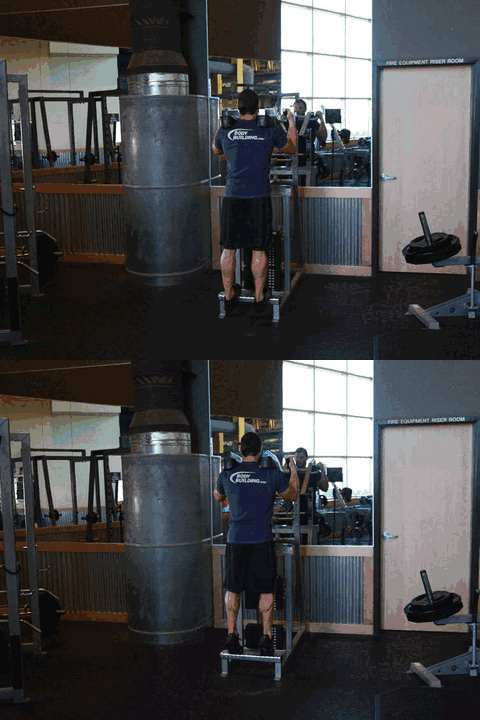
Standing calf raise: start and finish positions, looping
Standing calf raise
  1. Phase 12 x 8–12, 2-sec pause in the bottom stretch
  2. Phase 22–3 x 8–12
  3. Phase 33 x 8–12

Standing calf raise machine. The animation above shows this machine.

Form notes

  • Hack squat: feet a little higher and wider on the platform, toes out slightly. That keeps the heels planted and gives his belly room. Back and hips stay glued to the pad.
  • Hip thrust: chin tucked, ribs down, push through the heels. Stop at full hip extension and don't arch the low back to get higher.
  • Calf raise: the slow stretch at the bottom is the point. It builds the ankle range his squat needs.

Odd weeks

Day D: Hamstrings & Glutes (both legs)

This is where his RDL gets built. Two hinge movements in one session is a lot for a beginner's low back, so the straight-leg RDL starts as a cable pull-through.

Hamstrings, Glutes Low back, Outer hip, Quads

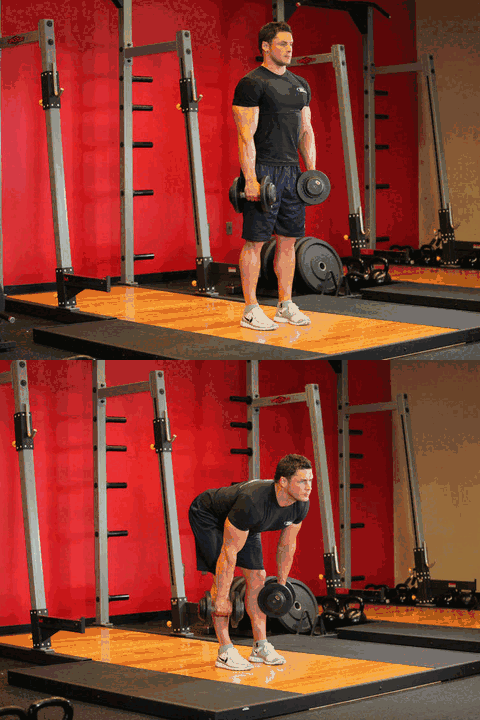
Romanian deadlift

Hamstrings, Glutes, Low back

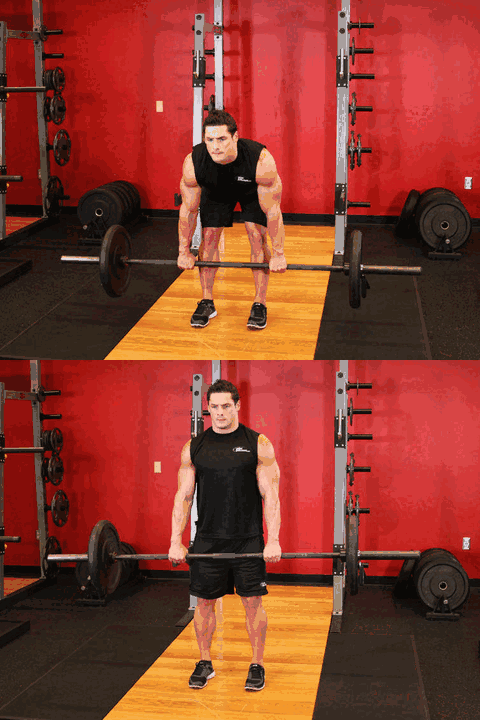
Romanian deadlift: start and finish positions, looping
Romanian deadlift. The barbell version from Phase 3. Dumbbells follow the same path.
  1. Phase 1Dumbbell RDL, 20–30 lb each, 2 x 8–10. First set with a dowel to groove the hinge
  2. Phase 2Dumbbell RDL, 35–50 lb each, 3 x 6–8
  3. Phase 3Barbell RDL, start 75–105 lb, 3 x 6–8

Straight-leg RDL

Glutes, Hamstrings

Cable pull-through: start and finish positions, looping
Cable pull-through
Straight-leg RDL with dumbbells: start and finish positions, looping
Straight-leg RDL with dumbbells
  1. Phase 1Cable pull-through, 2 x 8–10
  2. Phase 2Dumbbell straight-leg RDL, 20–30 lb each, to just below the knee, 3 x 8
  3. Phase 3Barbell straight-leg RDL, 55–75 lb, 3 x 6–8
Cable station
Cable station. Photo: Teemeah, CC BY-SA 4.0

Leg press

Quads, Glutes

Leg press: start and finish positions, looping
Leg press
  1. Phase 1Both legs, feet high and wide, 2 x 8–10, start ~160–200 lb
  2. Phase 22–3 x 6–10
  3. Phase 33 x 6–8
Leg press sled
Leg press sled. Photo: Teemeah, CC BY-SA 4.0

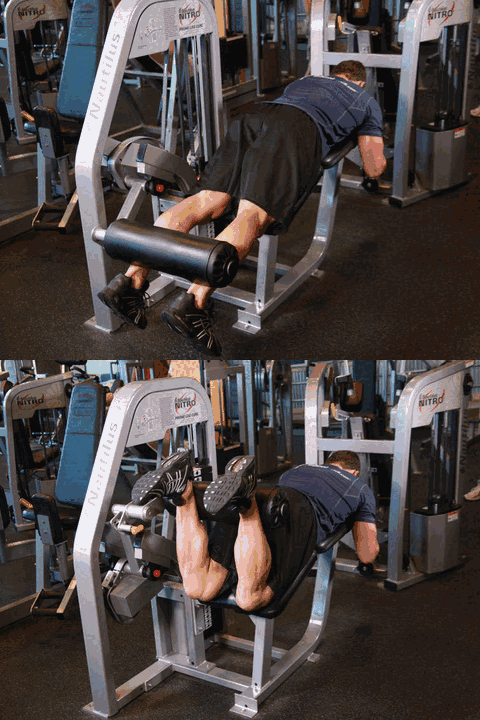
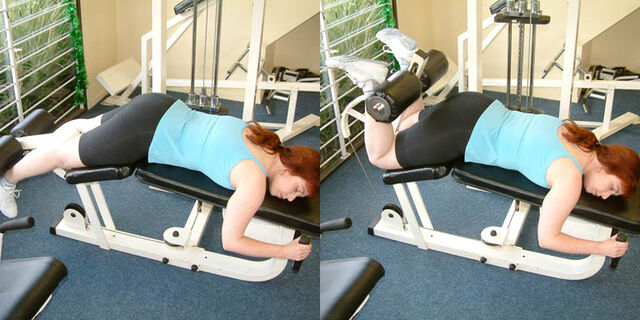
Lying leg curl

Hamstrings

Lying leg curl: start and finish positions, looping
Lying leg curl
  1. Phase 12 x 8–10, start ~50–70 lb
  2. Phase 22–3 x 6–10
  3. Phase 33 x 6–10
Lying leg curl machine
Lying leg curl machine. Photo: GeorgeStepanek, CC BY-SA 3.0

Hip abductor

Outer hip, Glutes

Hip abductor machine: start and finish positions, looping
Hip abductor machine
  1. Phase 12 x 10–12, start ~70–90 lb
  2. Phase 22–3 x 8–12
  3. Phase 33 x 8–12
Hip abductor machine
Hip abductor machine. Photo: Teemeah, CC BY-SA 4.0

Form notes

  • RDL: weights stay touching the thighs the whole way, soft knees, hips push back. Lower until the hamstrings stretch or the back wants to round, then drive the hips forward to stand. Wider feet give his belly room as he hinges.
  • Straight-leg RDL: a nearly straight knee makes it a bigger hamstring stretch, so his range will be short at first. Let it grow on its own and don't force it.
  • Leg press, feet high: on this day, feet near the top of the platform shift the work to glutes and hamstrings.

Road map to the goal lifts

He moves up a step only when he passes the checkpoint with clean form. If a new step feels shaky, go back one step for another round.

Barbell back squat

  1. Heel-elevated box squat
  2. Goblet box squat
  3. Goblet squat, no box
  4. Smith machine or barbell box squat (45 lb bar)
  5. Barbell back squat

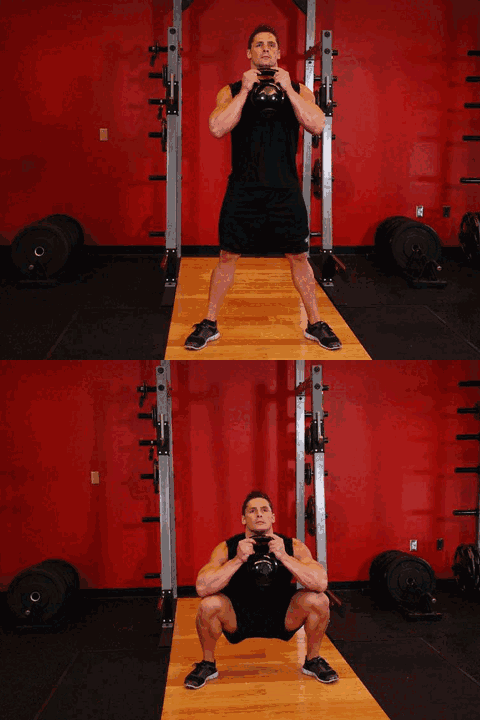
Checkpoint: Goblet squat 3 x 8 with ~45–55 lb: heels down, thighs near parallel, back flat
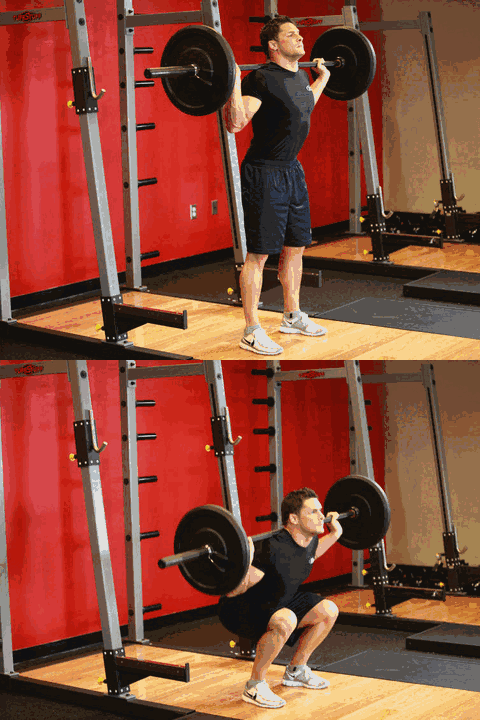
Barbell back squat: start and finish positions, looping
Barbell back squat
Goblet squat: start and finish positions, looping
Goblet squat
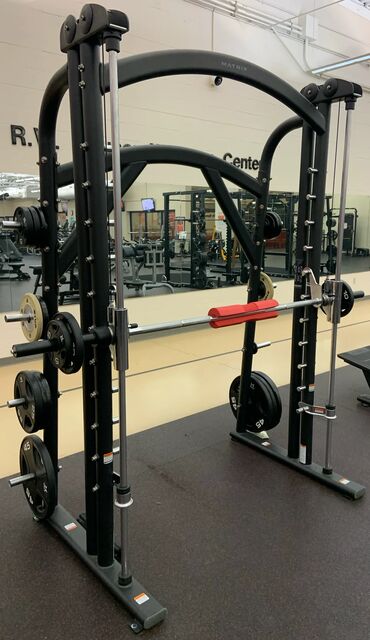
Smith machine
Smith machine. Photo: Wikideas1, CC0

Romanian deadlift

  1. Dowel hinge
  2. Dumbbell RDL
  3. Barbell RDL

Checkpoint: Dumbbell RDL 3 x 8 with 45–50 lb each, flat back, weights touching the thighs

Romanian deadlift: start and finish positions, looping
Romanian deadlift. The barbell version from Phase 3. Dumbbells follow the same path.

Weighted lunges

  1. Supported split squat
  2. Split squat, no hands
  3. Reverse lunge (bodyweight)
  4. Reverse lunge with dumbbells
  5. Walking lunges with dumbbells

Checkpoint: Split squat 3 x 10 per leg with no hands and no wobble. Reverse lunges come before forward or walking lunges because they are easier on the knees and on balance
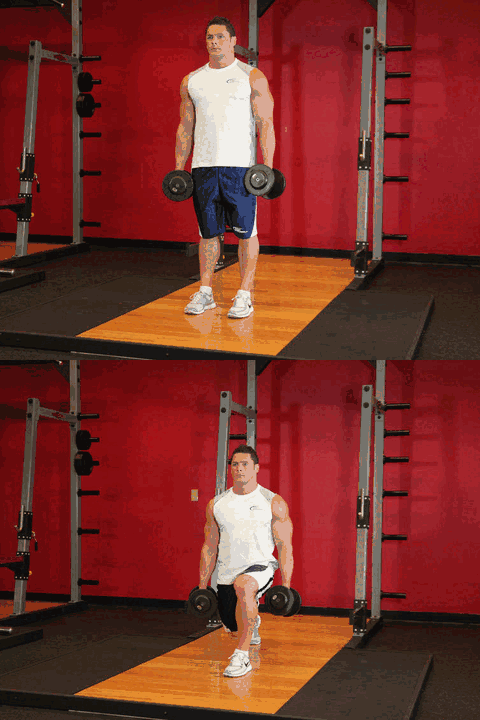
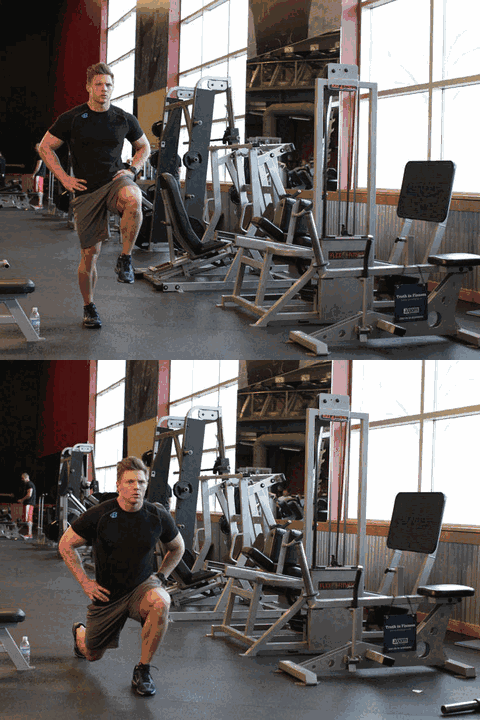
Reverse lunge with dumbbells: start and finish positions, looping
Reverse lunge with dumbbells
Walking lunge: start and finish positions, looping
Walking lunge

Bulgarian split squat

  1. Split squat
  2. Back foot on a 6–8" step
  3. Back foot on a bench
  4. Bench with dumbbells

Checkpoint: Each step: 3 x 8 per leg, steady, with no hands

Bulgarian split squat: start and finish positions, looping
Bulgarian split squat. The Phase 3 version. Phases 1 and 2 keep the back foot on the floor.

Single-leg RDL

  1. Dumbbell RDL (Day D)
  2. Kickstand RDL
  3. Single-leg RDL, hand on a rack
  4. Free single-leg RDL with a dumbbell

Checkpoint: Kickstand RDL 3 x 8 per side with control, and a 30-sec single-leg stand on each side

Single-leg RDL: start and finish positions, looping
Single-leg RDL. Shown with a kettlebell. A dumbbell works the same way.

Safety, heel lift and belly fat

Heel lift in the squat

Three things stack up: stiff ankles, long thigh bones at 6'4", and belly mass that blocks his hips from folding at depth. The result is that he tips forward onto his toes. The fixes:

  • Raise his heels on plates or a wedge now. It is a legitimate setup, not a cheat. Weightlifting shoes do the same thing later.
  • Ankle rocks every leg day, plus calf raises with a slow stretch.
  • Stance a little wider than shoulders, toes out 15–30°, so his belly fits between his thighs.
  • A goblet weight held in front counterbalances him so he can sit down without tipping.
  • Squat only as deep as his heels stay down. Depth comes as his ankles loosen.

Staying safe

  • Muscle burn and next-day soreness are normal, especially in weeks 1–2. Sharp or joint pain in the knee, hip or low back means stop that exercise and go back a phase.
  • Brace before each rep: a big breath into the belly, then tighten as if about to be poked. Don't hold the breath through many reps in a row.
  • If he has high blood pressure, past joint injuries or another health condition, a quick check-in with his doctor before ramping up is worth it.

Belly fat

Leg training can't spot-reduce the belly, but these are his biggest muscles, so building them raises what he burns. The fat itself comes off mostly through food and daily movement: protein at every meal, a modest calorie deficit, and plenty of walking on non-leg days.

Sources and credits